
FAKE ID REPLICA IRISH & FAKE CUSTOM IRELAND DRIVING LICENCE

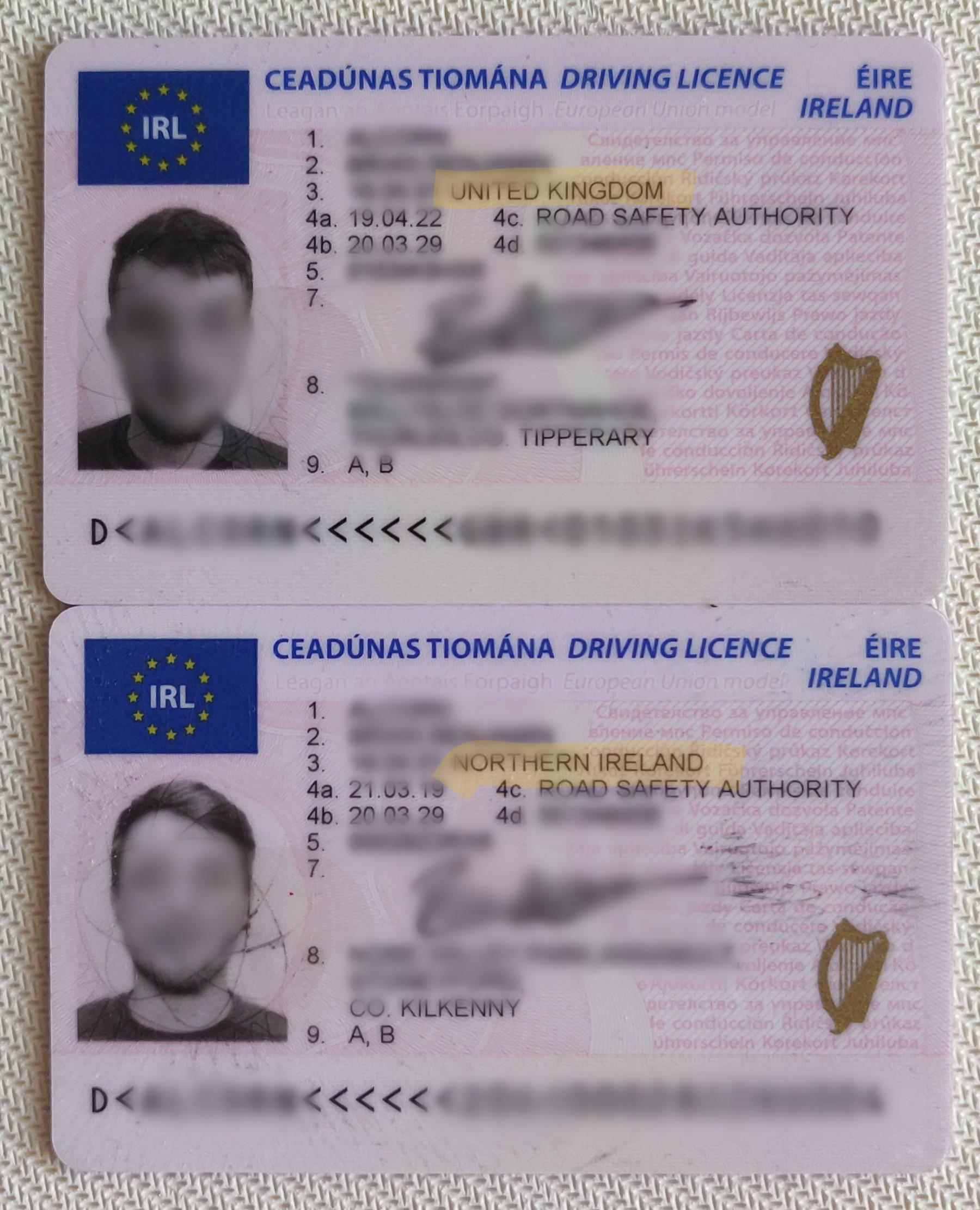
IRELAND DRIVING LICENCE & IRISH ID CARD
FAKE ID REPLICA IRISH & FAKE CUSTOM IRELAND DRIVING LICENCE
Irish Driving Licence:
Ireland’s licensing system is administered by the National Driver Licence Service (NDLS) under the Road Safety Authority (RSA), and it operates within an EU framework — the licence format, vehicle categories and driving test standards are all set at EU level. Two features make the Irish system distinctive: a mandatory 12-lesson training programme before you can test, and a six-month minimum learner period with no exceptions.
What Is an Irish Driving Licence?
An Irish driving licence authorises you to drive specific categories of vehicle on Irish roads. Ireland uses EU-standard categories, and the licence itself is set to a European format.
The path runs through four stages:
- Driver Theory Test
- Learner Permit
- Essential Driver Training (EDT)
- Driving Test → Driving Licence
Irish Licence Categories
| Category | Vehicle Type | Minimum Age |
|---|---|---|
| AM | Mopeds and light quadricycles | 16 years |
| A1 | Motorcycles up to 125cc, power not exceeding 11 kW, power-to-weight not exceeding 0.1 kW/kg. Motor tricycles with power not exceeding 15 kW | 16 years |
| A2 | Motorcycles with power not exceeding 35 kW, power-to-weight not exceeding 0.2 kW/kg, not derived from a vehicle of more than double its power | 18 years |
| A | Motorcycles | 24 years, or 20 with progressive access |
| A (motor tricycles) | Motor tricycles | 21 years |
| B | Vehicles other than motorcycles, mopeds, work vehicles or land tractors, with a MAM not exceeding 3,500 kg, passenger accommodation for no more than 8 persons, and where the trailer’s MAM is not greater than 750 kg or the combined MAM doesn’t exceed 3,500 kg | — |
| W | Tractors and work vehicles | — |
| C1, C | Trucks | — |
| D1, D | Buses | — |
| BE | Car and trailer | — |
A useful category B note: alternatively fuelled vehicles with a MAM exceeding 3,500 kg but not exceeding 4,250 kg can be driven for the transport of goods operating without a trailer by holders of a category B licence issued at least two years before — provided the excess mass is due exclusively to the propulsion system and the cargo capacity isn’t increased.
Step 1: The Driver Theory Test
Before you can apply for a learner permit, you must pass a driver theory test. The test checks your knowledge of topics including:
- The Rules of the Road
- Risk perception
- Eco-driving
- Hazard awareness
- Safe driving behaviour
The driver theory test is computer-based.
A critical deadline: you need to apply for your learner permit within two years of passing your theory test — or you’ll have to repeat it and pay another fee.
Step 2: The Learner Permit
Your learner permit allows you to drive on all public roads, except motorways, for the purpose of learning to drive.
What You Need to Apply
Applying online has become the standard route — no paper forms, appointments or centre visits needed. You’ll need:
- A Public Services Card (PSC) and verified MyGovID
- A fully completed eyesight report form dated within three months, if required in your case
- A fully completed medical report form dated within three months, if required in your case
- Proof of your address dated within the last six months if your current address differs from the one you provided when applying for your PSC
- Proof that you are normally resident in Ireland if your place of birth and nationality are outside the EU/EEA/Switzerland/UK/Northern Ireland
- A completed relevant Driver CPC certificate, if required
- The application fee of €45
If you’re aged 70 years or over, you are exempt from paying the fee.
Additional requirements for a first learner permit include the Theory Test Pass Certificate, which must have been issued within 2 years of the date of application, evidence of identity, evidence of residency entitlement, PPSN and address dated within 6 months, a medical report if applicable dated within one month, and an eyesight report dated within one month.
For truck and bus categories (C1, C, D1, D), all applicants need a medical report, and you must show proof of a full licence for a category B vehicle.
Learner Permit Restrictions
Ireland’s learner restrictions are strict, and several carry fixed charges.
You must:
- Be accompanied at all times by an Approved Driving Instructor (ADI) or someone who has held a full, valid driving licence in the same category for more than two years
- Display L-plates at all times on any vehicle you drive
- Keep to a reduced drink-driving limit and penalty point disqualification threshold
Who can accompany you: a qualified driver holds a full driving licence in the category of vehicle being driven for a minimum of two years. A person who can drive in Ireland under a licence issued by an EU Member State, an EEA country, or a holder of a Ukraine driving licence in category B living in Ireland under temporary protection, can act as a qualified driver. Otherwise a foreign licence holder cannot act as a qualified driver.
What you cannot do:
- Drive on a motorway in any vehicle category
- Carry any passenger for reward
- Drive while towing a trailer if you hold a learner permit in categories B, C1, C, D1 or D
- Act as an accompanying driver for another learner
An important consequence for car owners: if you own a car, you’ll be guilty of an offence if you let someone drive it in a public place when they don’t have a licence or learner permit, or have a learner permit but drive your car without being accompanied by a qualified driver.
And a real deterrent: if the Gardaí stop you and you are not accompanied by a qualified driver, they can take and keep your car.
L-plate specifics: the L must be at least 15 cm high, red on a white background. Motorcycle and moped learners display the L on a yellow fluorescent tabard on the front and back of the body.
Step 3: Essential Driver Training (EDT)
Essential Driver Training is a structured training programme consisting of 12 driving sessions with an Approved Driving Instructor (ADI) — or six sessions if you are eligible for reduced EDT.
Since 4 April 2011, every new first-time car learner permit holder must complete EDT with an ADI. The course is 12 one-hour lessons, each signed off in a logbook, and the logbook may have to be produced before the driving test.
Reduced EDT: Six Lessons Instead of Twelve
If you hold a foreign licence you may be eligible for reduced EDT — six driver training sessions rather than twelve.
Specifically: a reduced EDT programme is available for drivers who currently hold a full car licence (category B) from a country that does not have a licence exchange agreement with Ireland.
This matters for drivers from the United States, India, Brazil and most other countries — you can’t exchange your licence, but you take six EDT lessons rather than twelve.
Motorcycle Equivalent: IBT
Instead of EDT, motorcycle learners complete Initial Basic Training (IBT) — a 16 or 18-hour IBT course.
The Six-Month Rule
If you hold a first learner permit in category A, A2, A1, AM, B or W, you must have held it for six months before you can sit the driving test in that category.
The period runs from the date the category was added to your permit, and the rule does not apply to category BE.
An exemption is possible for someone who has held a full foreign licence for more than six months.
Multiple Learner Permits: The November 2026 Changes
New measures took effect on 1 November 2026 for learner permit holders in cars (category B), tractors or work vehicles (category W), and motorcycles and mopeds (categories A, A1, A2 and AM). These rules focus on reducing the number of people holding multiple learner permits who don’t attempt to sit a driving test.
The core change: since 1 November 2026:
- You will no longer be able to get a third or fourth learner permit just by applying for a driving test
- To be eligible for a third or fourth learner permit, you must have taken a driving test within the previous two years
- You won’t be able to get more than four learner permits unless you were medically restricted. After your fourth permit, you will have to start the learning to drive process again — though permit holders still have the life of their permit in which to take a driving test
Permit duration rules for car categories: first and second learner permits are issued for 2 years; a third or subsequent permit is issued for 2 years if you’ve undergone a driving test in the previous 2 years, or 1 year if you’ve applied for a driving test in that category.
An additional trap: if you have held learner permits for seven or more years, irrespective of the number of permits, you will not be able to renew your learner permit — you must start the learning to drive process again.
And on expired categories: if a category on your learner permit has expired for 2 years or more, you won’t be able to renew the category, and you’ll need to start the learning to drive process again. This applies to all categories of vehicles.
You can renew a learner permit up to 2 years after its expiry date, subject to renewal rules.
On exchanging: learner permits are only valid for driving in the country of issue and are non-exchangeable.
Step 4: The Driving Test and Licence
You can apply for your driving test when you hold a learner permit — but first-time learner permit holders must hold the permit for six months and complete EDT or IBT before sitting the test.
After passing your driving test, you can apply for a driving licence online or in person at one of the 34 NDLS centres nationwide.
A second critical deadline: you should apply within two years of the date you passed your test. If not, you will have to re-sit and pass the driving test.
To apply for your driving licence online you’ll need a Public Services Card and verified MyGovID, proof of having passed the driving test in the category, and proof of address dated within the last six months if your current address differs from your PSC record.
N-Plates and Novice Drivers
You must display novice plates (N-plates) on your vehicle for two years after receiving your first driving licence.
The RSA’s rationale is explicit: novice drivers are most likely to be killed on Irish roads in the first two years after passing their test due to their inexperience.
Special conditions applying during the two-year novice period:
- You must display N-plates on your vehicle for the first two years — and on any other vehicle in respect of which you get a driving licence
- You cannot act as a sponsor or accompanying driver for a category B learner driver
- A lower blood alcohol concentration threshold applies (20mg)
- A lower threshold of seven penalty points leading to disqualification usually applies
Where the vehicle is a motorcycle, the rider must wear an N-tabard.
A useful clarification: the novice period applies only once. Someone who holds a driving licence for one category and who, after two years, becomes entitled to drive another category does not become a novice in respect of the new category.
Penalty Points: The Learner and Novice Threshold
Any driver accumulating 12 penalty points within any given three-year period will be automatically disqualified from driving for six months.
A lower threshold of seven penalty points leading to disqualification applies to any driver who is granted their first learner permit on or after 1 August 2014 — while they drive under a learner permit, and subsequently during the first two years while they drive under their first driving licence.
Where a driver held a learner permit before 1 August 2014 and obtains a first full licence after that date, they will be disqualified on accumulating 12 penalty points in a 3-year period, or on accumulating 7 new penalty points after 1 August 2014, whichever comes first — until they have held the driving licence for 2 years.
Fixed Charges for Learner and Novice Offences
| Offence | Fixed Charge |
|---|---|
| Learner driving unaccompanied | €160 |
| Learner not displaying L-plates | €120 |
| Novice driver not displaying N-plates | €120 |
On driving unaccompanied specifically: the offence carries an initial €160 fine and 2 penalty points. If you don’t pay within 28 days, the fine increases first to €240. If you don’t pay that and are summoned to court, you can pay double the original fine — €320 — and accept the penalty points 7 days before the court date.
Since 27 October 2022, fines for road traffic offences such as speeding, mobile phone use, non-wearing of seatbelts, and failure to ensure a child is properly restrained have been doubled. Certain fines relating to safety offences committed by learner and novice drivers have also been increased.
Irish Driving Licence Fees
A payment note worth knowing: payment at NDLS centres can only be made by credit/debit card, Google Pay/Apple Pay, or Payzone vouchers. Cash, cheques and postal orders are not accepted.
Learner Permits
| Item | Fee |
|---|---|
| First time or renewal application | €45 |
| Add or remove category | €35 |
| One year learner permit (medical grounds) | €45 |
| Replacement or duplicate | €35 |
| First time or renewal for drivers aged 70 or over | €0 |
| Updating personal details | €0 |
Driving Licences
| Item | Fee |
|---|---|
| First time or renewal application | €65 |
| Add or remove category | €35 |
| Three year licence (age or medical grounds) | €35 |
| One year licence (medical grounds) | €0 |
| Replacement or duplicate licence | €35 |
| Exchange of a foreign licence | €65 |
| First time or renewal for drivers aged 70 or over | €0 |
Licence Validity
Duration depends on your age and medical fitness:
| Period | Licence Categories |
|---|---|
| 10 years | Group 1 — Motorcycles, Cars and Tractors |
| 5 years | Group 2 — Buses, Trucks and Articulated Vehicles |
| Your Age | Licence Term |
|---|---|
| Under 65 | Maximum 10-year licence for cars and motorcycles, or maximum 5-year licence for trucks and buses |
| 65 to 71 | A licence expiring on the eve of your 75th birthday at the latest — though Group 2 categories (trucks and buses) will be for a maximum of five years, which could expire before you turn 75 |
| 72 to 74 | 3-year licence |
Renewing: you can apply to renew your driving licence within three months of its expiry date. You can renew online — no paper forms, appointments or centre visits needed — with a PSC and verified MyGovID, plus proof of address dated within the last six months if it differs from your PSC record.
You may also apply to renew a licence that has expired within the past ten years.
Exchanging a Foreign Driving Licence
Ireland’s exchange rules depend heavily on where your licence was issued.
EU and EEA Licences
If you have a driving licence issued by an EU/EEA member state, you can drive in Ireland as long as your existing licence is valid.
Exchanging is optional — but if you wish to exchange it for an Irish licence, you must do so within 10 years of your driving licence expiring.
EU/EEA countries include: Austria, Belgium, Bulgaria, Croatia, Cyprus, Czechia, Denmark, Estonia, Finland, France, Germany, Greece, Hungary, Iceland, Ireland, Italy, Latvia, Liechtenstein, Lithuania, Luxembourg, Malta, Netherlands, Norway, Poland, Portugal, Romania, Slovakia, Slovenia, Spain and Sweden.
Two important catches:
- Where a driving licence has been issued in exchange for a licence from a country Ireland does not have an exchange agreement with, Ireland cannot exchange it. You’ll then need to follow the necessary steps to become a qualified driver in Ireland.
- Code 95 CPC does not transfer. Where the code 95 CPC is noted on an EU driving licence, it will not be transferred to the Irish licence — you must apply for a separate CPC card from the RSA.
Recognised States
If your licence was issued in one of these countries or territories, you can apply to exchange it for an Irish licence:
Australia (ACT, New South Wales, Northern Territory, Queensland, South Australia, Tasmania, Victoria, Western Australia), Canada (Alberta, British Columbia, Manitoba, New Brunswick, Newfoundland and Labrador, Ontario and Saskatchewan only), Georgia, Gibraltar, Guernsey, Isle of Man, Japan, Jersey, Moldova, New Zealand, Northern Ireland, Republic of Korea (South Korea), South Africa, Switzerland, Taiwan and the UK.
On Moldova: it was added from 27 April 2026. Under that Order, an automatic-only Moldovan licence is exchanged for an automatic-only Irish licence.
Not every category of licence can be exchanged in every case.
Timing: a licence from a recognised state must be exchanged within 1 year of its expiration date.
If You Cannot Exchange
If your driving licence is from a country that Ireland does not recognise for exchange, you can’t swap it for an Irish licence. You must go through the full driver licensing process starting with the driver theory test.
But there’s a significant concession: once you have your learner permit, you only need to take 6 Essential Driver Training lessons instead of 12.
This applies to licences from the United States, India, Brazil and most other countries.
Ukrainian Licences
Ukrainian licences can no longer be exchanged. However, a holder of a Ukraine driving licence in category B living in Ireland under temporary protection can act as a qualified driver for a learner.
Driving as a Visitor
- An EU or EEA licence can be used while it is valid
- A licence from a recognised state can be used by a visitor for up to one year
- If you live in Ireland, you can no longer drive on a UK licence — you must exchange it
Only a full licence can be exchanged. A foreign learner permit cannot be used to drive in Ireland or be exchanged.
Practical Tips for the Irish Licensing Process
Get the sequencing right:
- Pass the theory test first — you can’t apply for a learner permit without it
- Watch the two-year clocks. You have two years from passing the theory test to apply for your learner permit, and two years from passing the driving test to apply for your licence. Miss either and you start again.
For the learner period:
- Book your EDT lessons early. Twelve one-hour sessions take time to schedule, and you need the logbook.
- Don’t rely on a foreign friend as your accompanying driver. Only EU/EEA licence holders, and Ukraine category B licence holders under temporary protection, can act as a qualified driver. A US or Australian licence won’t do.
- Display your L-plates properly — at least 15 cm high, red on white. The fixed charge for not displaying them is €120.
- Never drive unaccompanied. Beyond the fine and points, the Gardaí can seize your car.
For the six-month wait:
- The clock starts when the category is added to your permit — diarise it
- Category BE is exempt from the six-month rule
- A full foreign licence held more than six months may exempt you — ask before assuming
Watch the November 2026 rules:
- Applying for a driving test no longer qualifies you for a third or fourth learner permit. You must have taken a test in the previous two years.
- Four permits is the ceiling without medical restriction, after which you restart the process
- Seven years of permits means you can no longer renew
For the novice period:
- Display your N-plates for two full years. The fixed charge is €120.
- Don’t offer to accompany a learner — novices can’t act as accompanying drivers
- Mind the lower drink-drive threshold of 20mg
A significant point for experienced drivers arriving from abroad:
- Check whether your country is on the recognised list before assuming you’ll need the full process. Australians, Canadians from seven provinces, New Zealanders, South Koreans, South Africans, Japanese, Taiwanese, Swiss and UK licence holders can exchange.
- If you can’t exchange, you still get a break — six EDT lessons rather than twelve.
Frequently Asked Questions
What’s the first step to getting an Irish driving licence? Passing the driver theory test. You can’t apply for a learner permit without it.
How long is a theory test pass valid? You must apply for your learner permit within two years of passing, or repeat the test and pay again.
What does a learner permit allow? Driving on all public roads except motorways, for the purpose of learning, only when accompanied by an ADI or a driver who has held a full licence in the same category for more than two years.
Can I drive unaccompanied on a learner permit? No. The fine is €160 with 2 penalty points, rising to €240 if unpaid after 28 days, and the Gardaí can seize your car. This doesn’t apply to motorcycle or tractor learner permit holders.
Who can accompany a learner driver? Someone with a full licence in the same category held for at least two years. EU/EEA licence holders and Ukraine category B licence holders under temporary protection can also act as qualified drivers — other foreign licence holders cannot.
What is Essential Driver Training? A structured programme of 12 one-hour sessions with an Approved Driving Instructor, signed off in a logbook. Reduced EDT of 6 sessions applies if you hold a full car licence from a country Ireland has no exchange agreement with.
How long must I hold my learner permit before the driving test? Six months, for categories A, A2, A1, AM, B and W. The clock runs from when the category was added. Category BE is exempt.
When can I get a third or fourth learner permit? Since 1 November 2026, only if you have taken a driving test within the previous two years. Applying for a test is no longer sufficient.
How many learner permits can I hold? No more than four, unless medically restricted. After the fourth, you must start the learning to drive process again. Holding permits for seven or more years also ends renewal eligibility.
How long is a learner permit valid? 2 years for first and second permits. Third or subsequent permits are 2 years if you’ve tested recently, or 1 year if you’ve only applied.
What are N-plates and how long do I display them? Novice plates, required for two years after receiving your first full driving licence. Motorcyclists wear an N-tabard.
What are the novice driver conditions? N-plates for two years, no acting as an accompanying driver, a lower blood alcohol threshold of 20mg, and a seven penalty point disqualification threshold.
How many penalty points before disqualification? 12 points for most drivers within a three-year period → six-month disqualification. Seven points for those granted a first learner permit on or after 1 August 2014, during the learner period and the first two years of their first licence.
What are the fines for learner and novice offences? €160 for driving unaccompanied, €120 for not displaying L-plates, and €120 for not displaying N-plates.
How much does an Irish learner permit cost? €45, free if you’re 70 or over. Adding or removing a category is €35.
How much does an Irish driving licence cost? €65 for a first-time or renewal application, free if you’re 70 or over. Exchanging a foreign licence is also €65.
Can I pay cash at an NDLS centre? No. Payment is by credit/debit card, Google Pay/Apple Pay, or Payzone vouchers only.
How long is an Irish driving licence valid? 10 years for motorcycles, cars and tractors (Group 1), and 5 years for buses, trucks and articulated vehicles (Group 2). Terms shorten with age — from 65 to 71 a licence may expire on the eve of your 75th birthday, and at 72 to 74 it’s a 3-year licence.
When can I renew? Within three months of the expiry date, and you can renew online. Licences expired within the past ten years can also be renewed.
Can I exchange my foreign licence for an Irish one? Only if it’s from an EU/EEA country or a recognised state — Australia, seven Canadian provinces, Georgia, Gibraltar, Guernsey, the Isle of Man, Japan, Jersey, Moldova, New Zealand, Northern Ireland, South Korea, South Africa, Switzerland, Taiwan and the UK.
Can I exchange a US licence? No. You must go through the full process — but you only need 6 EDT lessons instead of 12.
How long do I have to exchange a recognised-state licence? Within 1 year of its expiration date. EU/EEA licences can be exchanged within 10 years of expiry.
Can I still drive on my UK licence in Ireland? If you live in Ireland, no — you must exchange it. Visitors can use a UK licence for up to one year.
Does Code 95 CPC transfer to an Irish licence? No. You must apply to the RSA for a separate CPC card.
Can I exchange a foreign learner permit? No. Learner permits are valid only in the country of issue and are non-exchangeable.
The Bottom Line
Ireland’s pathway is theory test → learner permit → Essential Driver Training → driving test → licence, with no shortcuts — until you hold a full licence from a recognised jurisdiction.
The numbers that matter: 12 EDT lessons (or 6 if you hold a full car licence from a non-exchange country); a six-month minimum learner period before testing; two-year deadlines both from passing the theory test to applying for your permit, and from passing the driving test to applying for your licence; €45 for the permit and €65 for the licence; and a two-year novice period on N-plates with a 20mg alcohol limit and a seven-point disqualification threshold.
Three rules carry real consequences. Driving unaccompanied costs €160 and two points — and the Gardaí can seize your car, while an owner who permits it commits an offence too. Novice drivers and new learner permit holders face a seven-point limit rather than twelve. And since 1 November 2026, you can no longer obtain a third or fourth learner permit just by applying for a test — you must have taken one within two years, with four permits the ceiling.
For drivers arriving from abroad, check the exchange list before assuming the worst. Australians, Canadians from seven provinces, New Zealanders, South Koreans, South Africans, Japanese, Taiwanese, Swiss and UK licence holders can exchange — while US, Indian and Brazilian licence holders can’t, but get the reduced six-lesson EDT route.